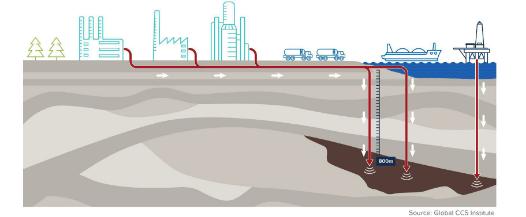

Carbon Capture and Storage (CCS) is a set of technologies that capture carbon at the source of generation in energy and industry and transport it underground geological formations for permanent storage. It will be nearly impossible to reach Net Zero without vastly scaling up CCUS, even if energy and industrial systems are rapidly decarbonized. Different estimates put the amount of carbon abatement through CCS at between 6 and 10 Gigaton per annum of Co2 captured to reach Net Zero, two-thirds of it in developing countries. And this assumes that the demand for fossil fuels will fall between now and 2050. Current trends indicate that the opposite is likely to happen, requiring even higher amounts of carbon capture.
So, are we on track to achieve these ambitious goals? The answer is no. While CCUS adoption is growing rapidly since 2017, the current capacity is only about 60 Mtpa, which will rise to around 100 Mtpa, when the projects currently being executed get completed. There is also an impressive pipeline of projects in different stages, which if completed, will take the total capacity to 480 Mtpa. However, that will still be just 5% of capacity needed by 2050. Given it takes an average of 7 years for a CCS project to come on stream, we have just a decade and a half to scale up CCS capacity over 20 times (more if fossil fuel use keeps rising)! It is even more challenging because of backsliding in the US, which is currently the market leader (followed by Europe). In Asia-Pacific, China leads the pack and is growing rapidly.
A transnational CCS value chain is inevitable as suitable storage sites are not always collocated with the carbon capture projects. Already a JV between Equinor, TotalEnergies and Norske Shell is receiving CO2 via ships from within Norway, and is on the verge of receiving them from Denmark and Netherlands. Singapore, South Korea and Japan will seek storage capacity in Malaysia, Indonesia and Australia, which have abundant sites.
Cost is another challenge to scaling up CCS. Depending on industry and location, it can vary from under USD 50 to as much as several hundred per ton. Funding such expensive projects in developing countries will not be easy. While it is possible to utilize the emitted Co2, it is mostly uncompetitive, except in a few use cases. Bold policy support, including subsidies, grants, and regulations will be needed to vastly accelerate the adoption of CCS. While it will be expensive, the cost of failure will likely be even higher.
Based on a discussion with Alex Zapantis, Strategic Advisor, Global CCS Institute