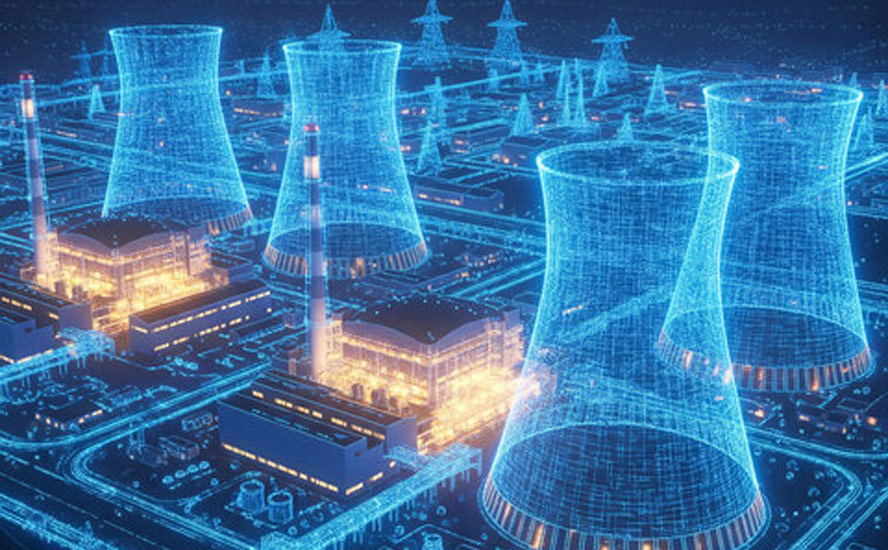

Nuclear energy has a lot to recommend it. It is clean, has a smaller physical footprint and is subject less to supply chain risks. Seems like it is tailor-made for countries like Singapore which are small, population dense, do not have natural resources and have a growing electricity demand, not least from AI data centres. Whether this is indeed the case, is what we discussed at a recent APAC AI and Sustainability Advisory Council session with Dr Alvin Chew of Rajaratnam School of International Studies.
A match made in heaven?
While Singapore has a decade old program to install solar panels on residential rooftops and industrial buildings and has installed floating solar panels on reservoirs, it simply does not have enough space to meet more than a fraction of its energy need through solar. Consider this –500-1000 acres of space is required to power a 100 MW data centre, which in the AI age is considered a modest one. Similarly, 200-4000 acres is needed to generate the same amount of electricity through wind turbines. What about import of electrons generated through clean energy from its neighbours who are more generously endowed with land? An ASEAN grid has been in the making, and some import does take place from Lao PDR (hydro power through Thailand and Malaysia), and plans are afoot to import renewable power from Indonesia and Cambodia too. However, even if various constraints are overcome and all these projects materialize, they will still not fully meet Singapore’s need for clean electricity. Can nuclear fill the gap? An IAEA Director General considered Singapore as the most perfect example of a country that needs nuclear energy. No wonder, Singapore is seriously exploring nuclear energy to power its electricity needs.
Not so fast!
However, there are also good reasons why Singapore needs to consider this option carefully because of associated risks. First, traditional nuclear projects usually entail large cost and time overruns. More importantly, past nuclear accidents in Chernobyl and Fukushima, cast a long shadow, especially in public imagination. To manage the risk associated with accidental leak of radiation, conventional nuclear plants require safety zones, that can stretch to several tens of kilometres, a luxury that Singapore does not have. Therefore, the choice for Singapore is to explore Small Modular Reactors (SMRs), which have a smaller footprint, faster deployment, and importantly, smaller safety zones. SMRs come in different types – scaled down versions of conventional light water reactors (which are relatively mature and face lesser regulatory hurdles) to the so-called Generation IV SMRs like Molten Salt Reactors and gas-cooled reactors. They are safer by design, and regulators, especially in the US are inclined to drastically reduce the safety / exclusion zones around them, making them suitable for dense areas. Singapore also has the option to deploy SMRs underground where hard granite rock provides natural protection against accidents and attacks. However, large scale deployment of advanced SMRs is still years away, and the regulatory regimes are still evolving. In any case, it will take years for Singapore to put in place the necessary capabilities, especially skills and regulatory framework in place. If all goes to plan, nuclear energy will make its appearance by 2040 in Singapore.
Singapore is not alone in exploring nuclear energy in ASEAN, as most other countries – Malaysia, Indonesia, Vietnam, Cambodia, Thailand and Myanmar – are also actively exploring it. It may well be renaissance of nuclear energy in this part of the world.