
“HR leaders will have to take responsibility for managing AI agents alongside human staff in the future,” according to the UK head of Accenture, quoted recently in the Financial Times. The CEO of TCS, another technology and business consultancy, has also said that his company will have half a million AI agents working alongside its employees. The tech industry has a history of creating hype around every new technology (hence Gartner’s Hype Cycle for the perplexed), but it is undeniable that something potent is brewing in the AI cauldron.
This note is based on an APAC AI and Sustainability Council meeting addressed by Manik Bhandari, Partner and Head of EY’s Agentic AI CoE in Singapore, and Raghu Bala, Founder of Synergetics.ai, a US-based Agentic AI startup.
Of talkers and doers
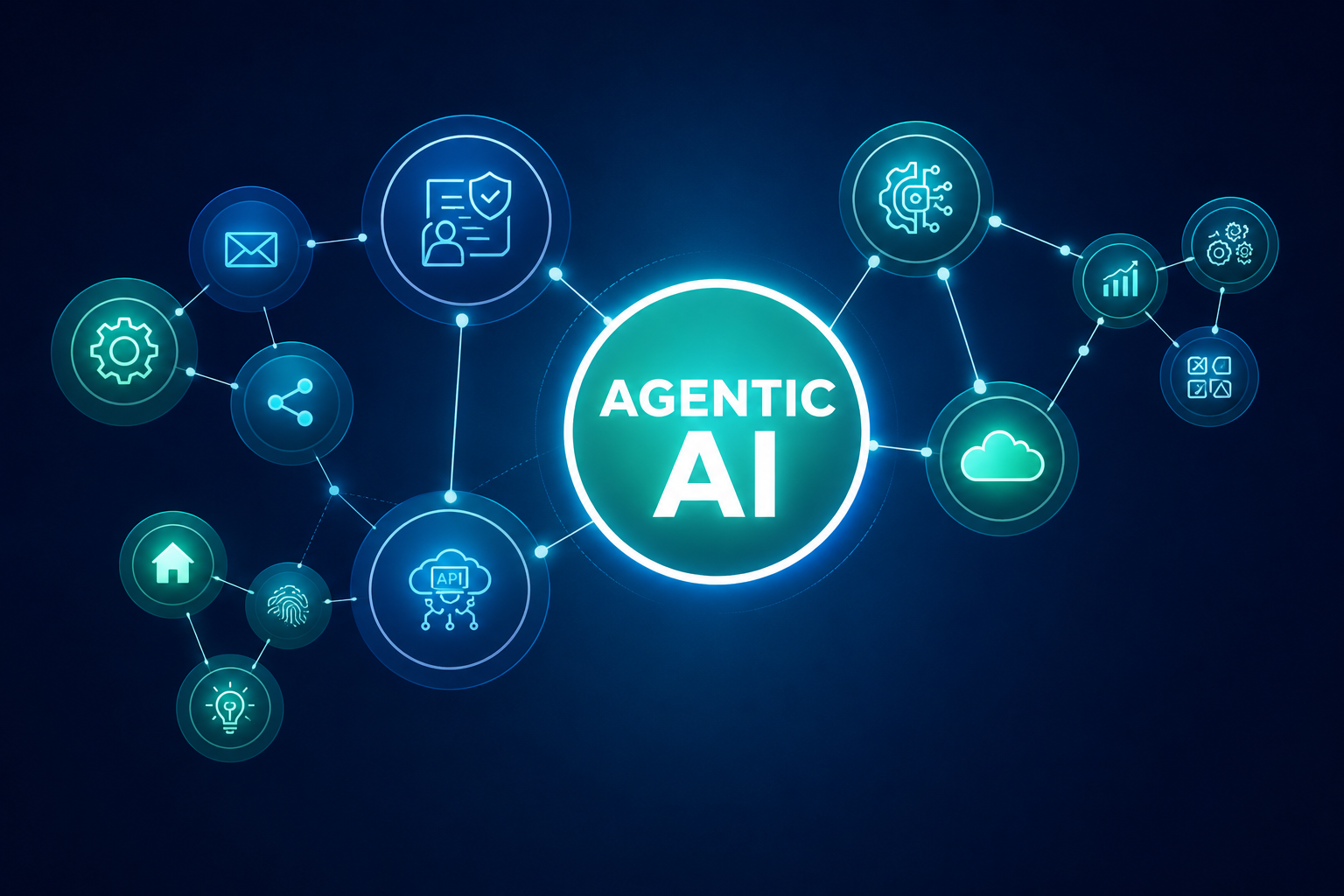
Like chatbots, AI agents leverage the capabilities of large language models (LLMs). However, unlike chatbots, which respond to a specific query, agents respond to an assigned goal, autonomously planning and executing tasks by invoking other agents, software applications, or even physical systems.
For instance, AI agents in an MRO organisation not only identify faults from images of an aircraft engine but also check inventory for required parts and order any that are missing, minimising downtime. They can then check engineers’ availability, block their calendars, and schedule repairs. This has enabled a 50% increase in throughput at the same facility. Effective scheduling is certainly possible without AI, but an agentic system’s ability to stitch together workflows and take action makes the process significantly faster.
Most early adopters, however, are focusing on less ambitious, “no-regret” use cases as they test the risks and capabilities of agentic AI. For example, at a consultancy, agents automatically fill consultants’ timesheets by gathering information from multiple systems, including calendars.
RPA by another name?
A comparison between agentic AI and Robotic Process Automation (RPA), a technology that gained prominence about a decade ago, is inevitable. RPA also sought to automate processes by linking different software systems. However, its utility was limited because hard-coded links are brittle and cannot cope with ambiguity, unexpected scenarios, process changes, or unstructured data.
An AI agent can be thought of as a supercharged RPA tool because it can handle all these challenges. For example, a telecom company has deployed agents that validate signatures on digitised forms and cross-reference government directories to match directors’ names as part of a customer onboarding process—something traditional RPAs cannot do.
Of new and old
The collapse in the market value of several business software companies this year may suggest that AI agents have obviated the need for the complex business logic embedded in those applications. That is not the case. AI agents orchestrate workflows by leveraging the functionality offered by enterprise applications such as ERP systems. What has changed is that a portion of the value has migrated from the application layer to the orchestration layer.
An accounting and finance use case illustrates this well. An agentic AI system accepts queries in plain English, gathers and analyses data from multiple sources—including PDF files—identifies likely drivers of performance variance, and returns its findings as a written response. While AI powers the interface and automation, the underlying systems continue to provide the data and accounting capabilities. In this sense, it is similar to the way autonomous vehicles combine AI with reliable control systems under the hood.
Power to the process
AI agents create opportunities to rethink conventional processes. EY today spends more time redesigning processes with agents in mind than writing code. Like other consultancies, EY is building process templates for core business workflows such as “procure-to-pay” and “order-to-cash,” as well as for specific industries.
This is not fundamentally different from the templates developed for ERP implementations in the past, except that they are now being adapted to the capabilities of AI agents.
Agents in the wild
Now imagine using your company badge to gain entry to another office or to open a bank account on behalf of your company. Both attempts would fail because a company badge proves identity within an organisation; it does not confer authority to transact on the organisation’s behalf.
The same is true for AI agents. Identity frameworks that work within an organisation are of little use outside it. To communicate, collaborate, and transact with agents beyond organisational boundaries, AI agents require identities and delegated authority that external agents and systems can reliably verify.
This requires an entirely new layer of infrastructure—a challenge that companies such as Synergetics.ai are addressing.
Raghu explained that Synergistic’s Agentic AI platform includes:
• A federated registry of agents
• A mechanism to provide a cryptographic identity and a signed delegation certificate on behalf of the agent’s owner
• A process for validating both identity and authority at the point of interactionThe road ahead
From being an obscure and esoteric concept, agentic AI is advancing rapidly. Over the coming years, a thriving marketplace for agents is likely to emerge, supported by foundational standards and infrastructure.
While some disruptors will build their businesses from the ground up around agentic capabilities, adoption among incumbents is likely to be slower as they wait for the technology and markets to mature before allowing agents into their core processes.
Meanwhile, companies and governments will need to assess the impact of AI on jobs, particularly at the entry level. One school of thought suggests that companies may adopt an apprenticeship model in which new recruits spend their first year learning how to create value in the new work environment before starting to get paid. Singapore is reportedly considering funding this transition, even as it embeds AI education throughout its curriculum, beginning at the pre-school level.